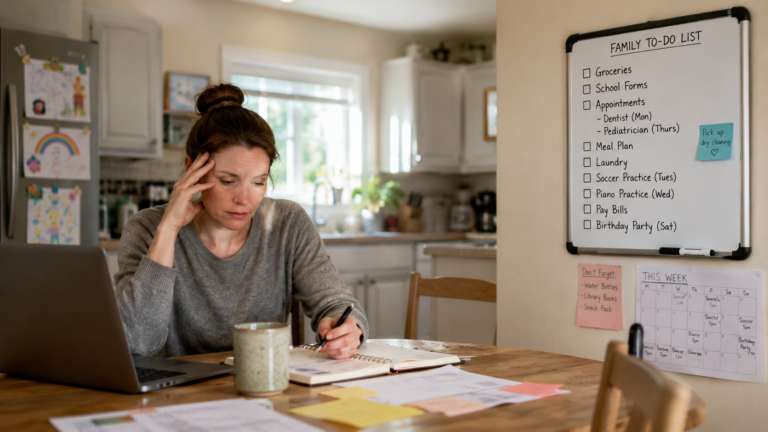




Summer has a way of making everyone forget what a clock is.
Bedtimes get later. Breakfast happens whenever someone remembers they are hungry. Pajamas may stay on until lunchtime, and “five more minutes” somehow turns into an entire afternoon.
Then school starts again, and suddenly everyone needs to wake up early, get dressed, eat breakfast, find a backpack, remember homework, and leave the house on time.
If your family is struggling with the transition, you are definitely not alone. A good back-to-school routine does not have to be complicated. The goal is simply to create enough structure that mornings become more predictable for everyone.
Why Back-to-School Routines Feel So Difficult
Going from relaxed summer days to a structured school schedule is a major transition for children. They may suddenly need to wake earlier, follow a different bedtime, manage school responsibilities, and spend several hours away from home.
Parents are making a transition too. You are suddenly coordinating lunches, transportation, homework, activities, school communication, clothing, schedules, and everything else that comes with the school year.
Current guidance from the Child Mind Institute recommends preparing children for the transition, listening to their concerns, practicing unfamiliar routines, and helping them become comfortable with their new environment.
That preparation does not need to happen perfectly. Even small changes can make the first weeks of school easier.
1. Reset Bedtime Before Resetting Everything Else
If summer bedtime has slowly moved later and later, do not expect your child to suddenly fall asleep two hours earlier because the school calendar says so.
Instead, gradually move bedtime and wake-up time toward the schedule your family needs. A consistent nighttime routine can also help signal that the day is winding down.
The Sleep Foundation recommends establishing a predictable bedtime routine and creating relaxing conditions that help children prepare for sleep.
That might mean a bath, pajamas, brushing teeth, reading together, and lights out at approximately the same time each evening.
The CDC notes that recommended sleep needs vary by age. School-age children ages 6 to 12 generally need 9 to 12 hours of sleep per day, while teenagers generally need 8 to 10 hours.
Better sleep will not magically eliminate every morning meltdown, but an adequately rested child is generally better prepared for the demands of a school day.

2. Create a Morning Routine Kids Can Actually Follow
“Get ready for school!” is a pretty vague instruction when a child is still half asleep.
Instead, break the morning into simple steps. For example:
- Get dressed
- Use the bathroom
- Eat breakfast
- Brush teeth
- Put on shoes
- Grab backpack
- Grab lunch and water bottle
- Leave the house
A visual checklist can be especially helpful for younger children or kids who struggle with organization and transitions.
Resources from Understood similarly recommend using lists, charts, and visual schedules to help children remember the steps involved in school routines.
You can also make the checklist part of your child’s responsibility. Instead of standing behind them repeating every instruction, encourage them to look at the list and complete each step independently.
3. Prepare as Much as Possible the Night Before
Morning is not the time to discover that nobody knows where the gym shoes are.
Move as many decisions as possible to the evening before. Have kids choose their clothes, pack backpacks, prepare lunch items, and put shoes near the door.
You can create a simple “school launch zone” near the entrance of your home where backpacks, shoes, jackets, lunch bags, and water bottles have designated places.
This works especially well when several children are getting ready at the same time.
For more simple household shortcuts, check out these sanity-saving mom hacks, including weekly outfit organization and morning routines designed to reduce daily chaos.
4. Give Kids More Responsibility
It can be tempting to do everything yourself because it is faster.
But if you always pack the backpack, choose the outfit, find the shoes, fill the water bottle, and remember every assignment, your child never gets the opportunity to practice those skills.
Age-appropriate responsibility can make school routines smoother while also building independence.
A younger child might put dirty clothes in the hamper and place their shoes by the door. An older child might pack their backpack, check their schedule, prepare simple lunch items, or set an alarm.
Give them responsibility gradually. The goal is not to hand your entire morning over to your child. It is to teach them that getting ready for school is a shared family responsibility.
5. Practice the Routine Before It Becomes Urgent
If mornings are consistently chaotic, try a practice run.
Choose a day when there is nowhere you need to be early. Set the alarm, follow the morning checklist, eat breakfast, get dressed, put on shoes, and walk through the normal departure routine.
You do not even have to leave the house.
The point is to discover where the routine breaks down. Maybe breakfast takes too long. Maybe your child cannot find their socks. Maybe the backpack is always missing something.
Fix those problems during a practice run instead of discovering them at 7:48 on a Monday morning.
The Child Mind Institute specifically recommends “test runs” for children who may feel anxious about returning to school. Repetition can make unfamiliar situations feel more manageable.
6. Do Not Ignore Back-to-School Anxiety
Not every difficult morning is about being tired or disorganized.
Some children genuinely worry about going back to school. They may be nervous about a new teacher, unfamiliar classroom, changing friendships, homework, academic expectations, or separating from their parents.
Listen before trying to solve the problem.
Instead of saying, “There is nothing to worry about,” try something like, “I can understand why that feels uncomfortable. Let’s think about what might make tomorrow easier.”
The Child Mind Institute’s guidance on back-to-school anxiety emphasizes listening to children’s concerns, validating their feelings, and helping them develop practical strategies for situations they find difficult.
7. Keep Afternoons Structured Too
The morning routine gets most of the attention, but after-school hours matter just as much.
Children can come home tired, hungry, and overstimulated. If they immediately move from school to screens, activities, snacks, and homework without any transition time, the afternoon can quickly become difficult.
Try creating a simple after-school rhythm:
- Come home and put belongings away
- Have a snack and drink water
- Take a short break
- Complete homework or reading
- Play or participate in activities
- Eat dinner
- Begin the evening routine
The exact schedule will depend on your child and family. The important part is having a predictable sequence.
If your child needs something hands-on after school, your kid-friendly DIY activity ideas can provide screen-free options for creative afternoons.
8. Keep Screen Time From Taking Over the Evening
After a long school day, children may want to relax with a tablet, television, game, or phone. There is nothing inherently wrong with that, but screens can make bedtime transitions harder for some families.
Set expectations before the screen comes out rather than announcing that screen time is over in the middle of a favorite game.
A simple warning system can help: “Ten minutes left,” followed by “Five minutes left.” Then transition into something predictable, such as dinner, a bath, reading, or quiet play.
For additional ideas, see Screen Time Management for Busy Moms.
9. Leave Room for Imperfect Mornings
Even the best routine will occasionally fall apart.
Someone will spill the cereal. A shoe will disappear. The homework will be sitting on the kitchen counter. Somebody will suddenly announce that today is the day they absolutely cannot go to school because their favorite shirt is in the laundry.
It happens.
Try not to turn one difficult morning into a judgment about your parenting. A routine is supposed to reduce stress, not create another standard you feel guilty about failing to meet.
Your article When Mom Snaps offers another useful reminder: imperfect parenting moments do not define you. What matters is how you reset and reconnect afterward.
10. Protect Your Own Morning Too
A calmer school morning should not mean Mom becomes the first person awake and the last person to breathe.
Build one small moment for yourself into the routine. Drink your coffee before it gets cold. Take five quiet minutes before waking everyone. Put your phone down while you get ready. Step outside for a minute after the kids leave.
If the school transition has left you feeling overwhelmed, revisit these mom burnout recovery tips or explore simple self-care ideas for moms.

A Simple Back-to-School Routine Checklist
If you want to simplify everything, start here:
- Sunday: Check the school calendar and upcoming activities.
- Night before: Choose clothes and pack backpacks.
- Morning: Follow the same basic checklist every day.
- After school: Create a predictable snack, break, and homework rhythm.
- Evening: Start winding down before bedtime.
- Weekly: Adjust the routine when something is consistently not working.
When a Routine Is Not Enough
Some children need additional support when returning to school. If anxiety is persistent or begins interfering with school attendance, sleep, eating, friendships, or everyday functioning, talk with your child’s pediatrician, school counselor, teacher, or an appropriate mental health professional.
Back-to-school worries are common, but persistent distress deserves attention rather than being dismissed as simply “not wanting to go to school.”
Final Thoughts
The perfect back-to-school routine does not exist. What works beautifully for one family may completely fall apart in another.
Start with the basics: consistent sleep, a simple morning checklist, preparation the night before, age-appropriate responsibility, and enough flexibility to handle the inevitable surprises.
Most importantly, remember that the goal is not to create perfectly behaved children who move through the morning like tiny employees.
The goal is to make family life a little easier.
Some mornings will still be chaotic. Someone will forget something. Someone will cry. You might even drink your coffee cold.
That’s motherhood.
But with a little preparation and a routine your family can actually live with, those hectic mornings can become calmer, more predictable, and much easier to handle.
And if all else fails, remember the most important back-to-school rule: everybody made it out of the house. That counts as a win.